Documentation
| Document | What it holds |
|---|---|
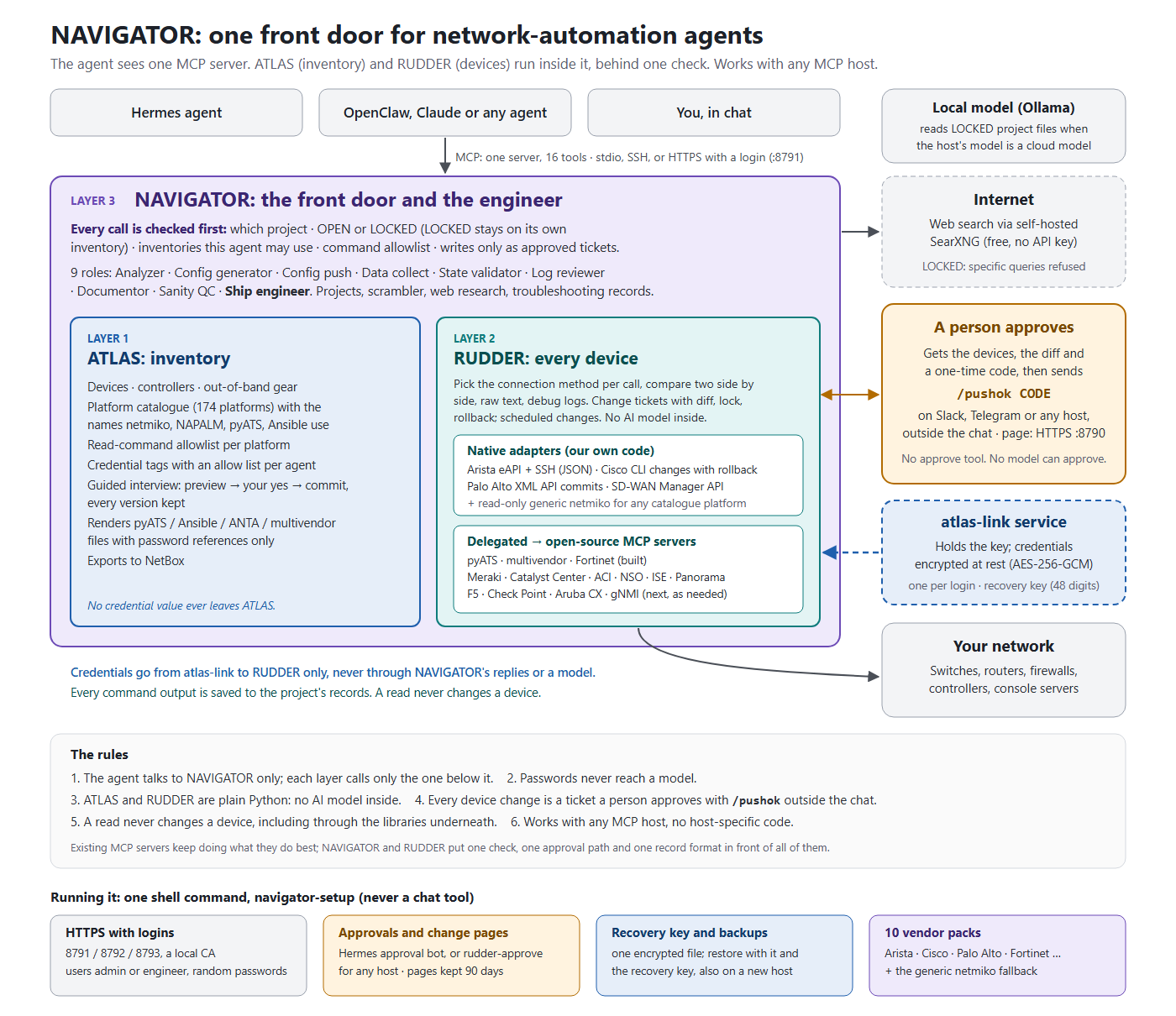
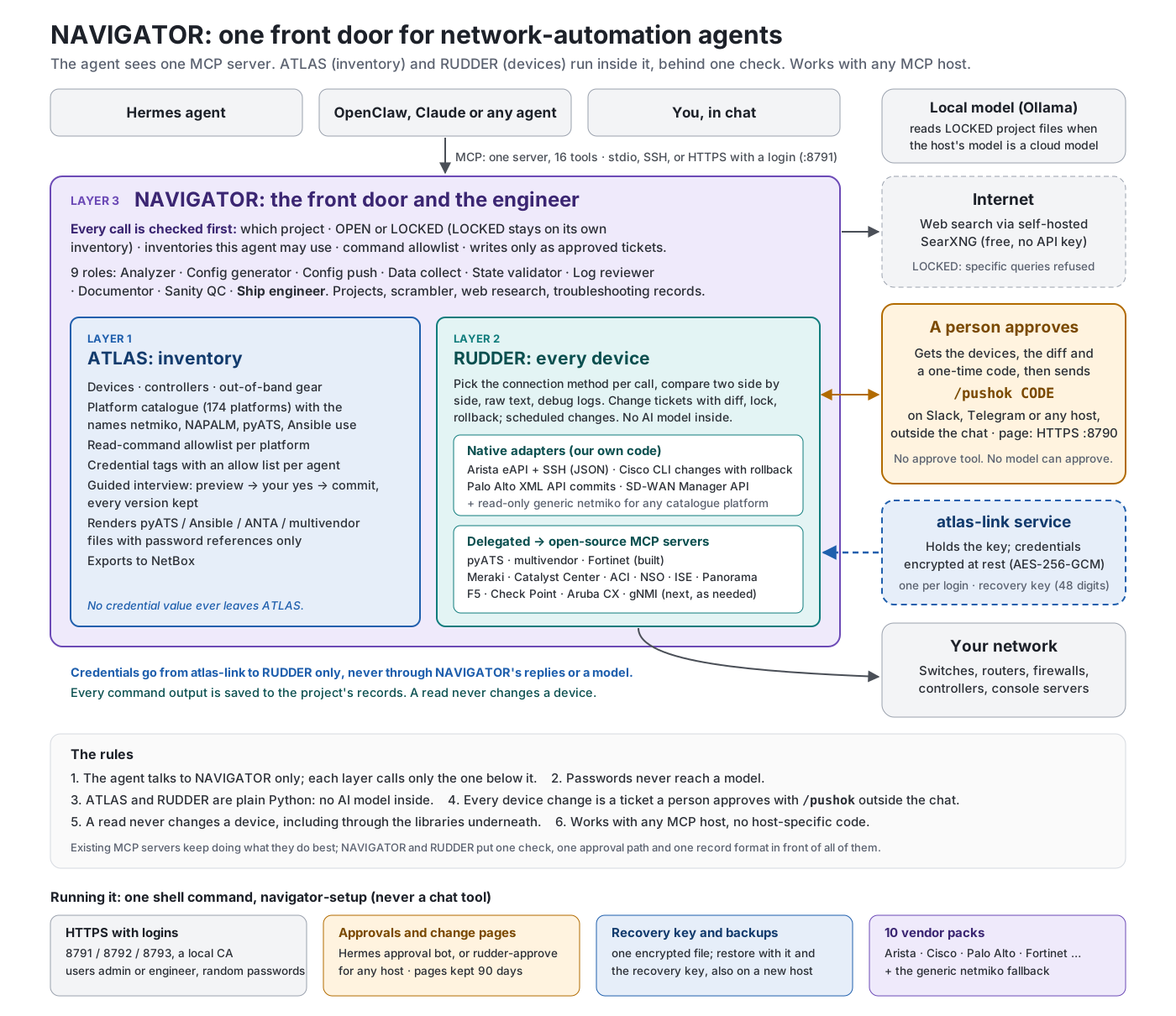
| THREE_LAYERS.md | Start here. What NAVIGATOR, ATLAS and RUDDER are, the front door, and the rules between them |
| navigator-architecture.html | The same as a web page |
| INTEGRATION.md | Connect a host: Hermes (a navigator profile, pyenv env NAVIGATOR), OpenClaw, Claude Code, Cursor, your own, and more; approvals per host |
| HOW_TO_USE.md | How to use it on any host: reads, changes, projects (PROJECT_ROOT, TASK.md, RUNLOG.md, RECORDS, RAW, OUT, OPEN / LOCKED), roles, scrambler |
| INTERVIEW.md | First-time setup and changing it later: navigator-setup, inventories, credentials, SKILLS_ROOT, PROJECT_ROOT, approvals, retention, cloud and local models |
| SHIP_ENGINEER.md | SHIP_ENGINEER manual: inventories, rendering, credential tests, connection methods (via=, compare, debug), recorded troubleshooting, vendor packs |
| LOCAL_MODELS.md | The one place for model rules: the CLOUD / LOCAL chat model (/model cloud, /model local), MODELS.*, local_model, navigator-guard, what LOCKED means for each |
| ../design/STATE_AND_MEMORY.md | What state and memory NAVIGATOR keeps, what a crash loses, why no database yet |
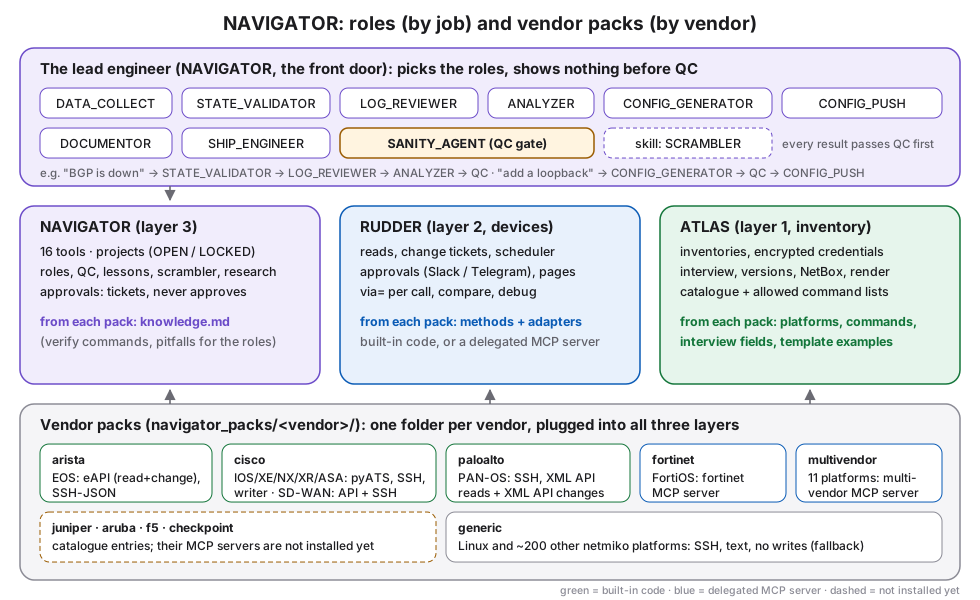
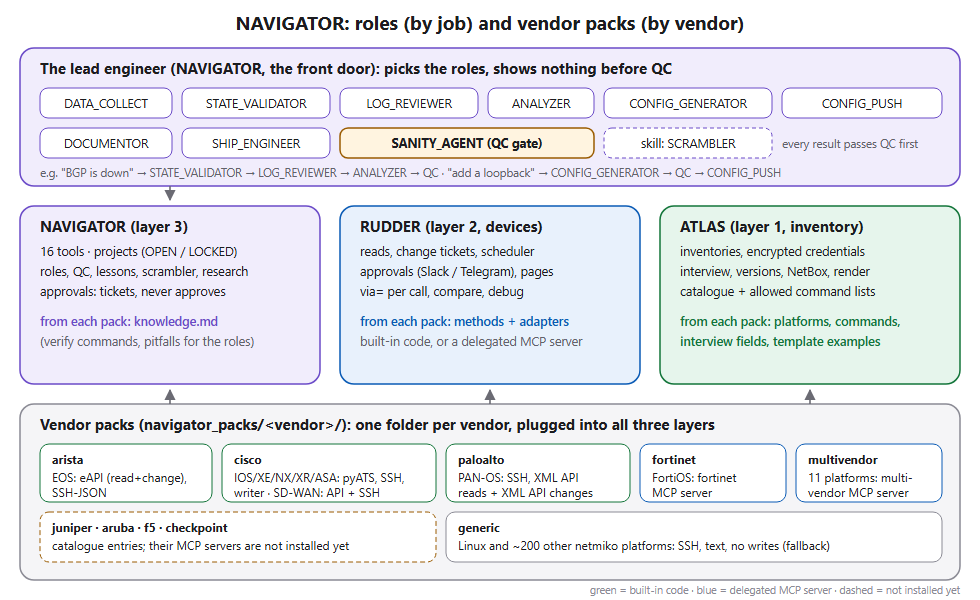
| ROLES_AND_PACKS.md | NAVIGATOR's specialist roles (DATA_COLLECT, STATE_VALIDATOR, LOG_REVIEWER, ANALYZER, CONFIG_GENERATOR, CONFIG_PUSH, DOCUMENTOR, SHIP_ENGINEER, SANITY_AGENT) and the vendor packs (what each vendor gets in ATLAS, RUDDER and NAVIGATOR; the proposed one-folder-per-vendor layout) |
| BACKUP.md | The recovery key, full backup and restore: the CREDENTIALS key, one encrypted file, restore on a new host |
| HTTPS.md | MCP over HTTPS on 8791-8793: local CA, users and roles, connecting remote clients |
| HOSTING.md | Where NAVIGATOR runs and how MCP hosts reach it (stdio, SSH, HTTP over a VPN) |
| CHEATSHEET.md | Chat phrases and the tool + action they map to |
| TESTING_CHAT.md | Testing: numbered chat tests for an agent using NAVIGATOR (inventory, reads, changes, scheduled changes, projects, scrambler, research, safety, the front door, Slack approvals, vendor packs, roles), with pass criteria |
| ATLAS.md | ATLAS in practice: files, changes, the atlas-link service (status, restart, install, troubleshooting) |
| SCHEDULER.md | Scheduled changes: approve in advance, 30 s notice with a stop code, the rudder-scheduler service |
| APPROVALS.md | Approval methods (Telegram / Slack, any platform through rudder-approve), approvers, navigator-setup, the change pages (TCP 8790, served directly by rudder-scheduler, no proxy), retention, ticket search |
| CLAUDE_CODE.md | Use NAVIGATOR from Claude Code / Cursor over SSH: what MCP is, set-up, the two interviews, troubleshooting |
| TESTING_CLAUDE_CODE.md | Testing: numbered tests from Claude Code, no Hermes (connect, reads, both interviews, a change, projects, safety) |
| SEARXNG.md | What SearXNG gives, where it runs, research, links to read more |
| roles-and-packs.svg / .png | The roles and vendor packs diagram |
| three-layers.svg / .png | The architecture diagram. The SVG is the only source: edit it, then run python scripts/render_diagrams.py to write the PNG and the copy inside navigator-architecture.html (--check fails if they differ) |
| ../integrations/hermes/README.md | The Hermes plugins (navigator-reply, push-approve, navigator-guard), the SOUL examples, the chat model aliases |
These are the internal docs. Some of them are also published at https://navigator.atomidea.com, with example names in place of private ones; ../docsite/README.md says which and how.
Each fact has one home; other documents link to it. The tool table is in ../README.md; model rules in LOCAL_MODELS; approvals in APPROVALS; setup keys in INTERVIEW.